
Australia has implemented a human papillomavirus (HPV) vaccination program since 2007, making it one of the first countries in the world to introduce HPV vaccination into the national immunization schedule. After more than a decade of practice, Australia has achieved remarkable progress in population coverage, optimization of implementation strategies, and disease control outcomes, and is expected to become the first country globally to eliminate cervical cancer.
Recently, Vicky Sheppeard, Director of the South Eastern Sydney Public Health Unit of the New South Wales (NSW) Ministry of Health, was invited to participate in a VaxLab online seminar, where she provided a detailed introduction to the implementation of school-based HPV vaccination in the state and revealed the systemic support behind its high coverage rates. This article synthesizes publicly available literature and information shared during the seminar to outline the implementation experience of school-based HPV vaccination in NSW.
The History of School-Based Vaccination Programs
The development of school-based vaccination programs in Australia can be traced back to the 1930s. In 1971, NSW took the lead in establishing a structured school vaccination service by providing rubella vaccination to female students in senior secondary school. In urban areas, vaccination services were delivered by teams of immunization nurses, while in rural areas, they were implemented by community health staff. This model laid the foundation for the expansion of school-based vaccination systems over the following decades. Subsequently, vaccines such as measles-mumps-rubella (MMR), diphtheria-tetanus-pertussis (dTpa), hepatitis B, and varicella were gradually introduced into school vaccination programs. By the early 21st century, a relatively mature school-based vaccination network covering multiple age groups and diseases had been established.
In 1998, NSW conducted a catch-up MMR vaccination campaign targeting all primary school students, achieving a coverage rate of 75.4%. However, routine school vaccination services were temporarily interrupted following the completion of this program. Between 1999 and 2003, hepatitis B vaccination was shifted to general practice based implementation, resulting in a low coverage rate of only 18% through private sector service provision. This experience prompted policymakers to re-prioritize school-based vaccination.
In 2003, the implementation of the national meningococcal C vaccination program marked a critical turning point for school vaccination in NSW. This program delivered large-scale vaccination to all primary and the whole of high school students (Year 7-12), administering a total of 823,197 students and achieving coverage rates of 76% in both primary and high schools. It demonstrated the efficiency and accessibility of the school-based model and led to the re-establishment of routine adolescent vaccination programs in the state. In 2004, a statewide dTpa vaccination campaign targeting high school (Year 7-12) students during a pertussis outbreak further consolidated this model. Currently, school-based vaccination programs in NSW for adolescents include HPV vaccination, and dTpa vaccination for Year 7 students and meningococcal ACWY vaccination for Year 10 students.
Implementation of the National HPV Program at NSW
In 2007, Australia launched the world’s first government-funded national HPV vaccination program. Coverage estimates from that year showed that HPV vaccination rates in nearly all school cohorts in NSW exceeded 70%, placing it among the leading states nationwide.
In 2008, NSW formally introduced the quadrivalent HPV vaccine (Gardasil 4) into school-based vaccination programs, initially targeting catch-up vaccination for older cohorts of secondary school girls. In the following years, HPV vaccination was gradually introduced into the routine immunization schedule for Year 7 students. In 2013, the program was expanded to boys, first through catch-up vaccination for older male students and subsequently through routine vaccination for Year 7 boys alongside girls, using a three-dose schedule at that time. In 2017, the schedule was simplified to two doses. In 2018, the nine-valent HPV vaccine (Gardasil 9) was introduced, also using a two-dose schedule. In 2023, the schedule was further simplified to a single-dose regimen.
New South Wales is the most populous state in Australia, divided into 15 local health districts (LHDs), with approximately 550 high schools (aged 12-18) and around 95,000 Year 7 cohorts annually. The state adopts a two-tier governance structure characterized by centralized coordination by the state health authority and decentralized implementation by local health districts, forming a closed-loop management system that integrates decision-making, execution, and feedback.
(1) Funding and Accessibility
The HPV vaccination program is jointly supported by the federal and state governments. Vaccines are procured by the federal government, while implementation costs are covered by the state government. Students receive vaccinations free of charge when vaccinated at school, and all adolescent vaccines included in the national immunization program are provided at no cost. If parents choose to have their children vaccinated at primary care facilities or pharmacies, the vaccine itself remains free, although service fees may be charged. Data indicate that more than 90% of students complete vaccination through school-based programs, demonstrating the significant advantages of this model in reducing financial barriers and improving accessibility.
(2) Governance: The Decision-Making and Implementation
In terms of governance structure, responsibilities are clearly divided and coordinated between decision-making and implementation. At the decision-making level, Health Protection NSW serves as the central authority responsible for strategic planning and overall supervision of the program. It provides all vaccines recommended and funded by the Australian government for adolescents and collaborates with the Department of Education, the Catholic Education Commission, and the Association of Independent Schools to secure policy support from the education sector. The state health authority ensures standardized operations across the state by developing annual implementation protocols and establishes informed consent mechanisms with multilingual informational materials to ensure accessibility and clarity. It also allocates funding to local health districts based on student population size and continuously monitors vaccination coverage, reporting data to support dynamic policy adjustments.
At the implementation level, the 15 local health districts are responsible for organizing vaccination activities within their jurisdictions. They coordinate directly with each high school to develop vaccination schedules tailored to local conditions, recruit and deploy trained registered nurses who are authorized to administer vaccines independently without a physician’s prescription, and manage vaccine procurement, storage, and cold chain logistics. Cold chain conditions are continuously monitored and recorded in accordance with national standards. Following vaccination, data are promptly reported to the Australian Immunisation Register (AIR). For students who are absent on vaccination days, catch-up services are arranged. For those unable to participate in school-based vaccination, alternative access through primary care providers is facilitated.
(3) End-to-End Service and Quality Management
The management of vaccination sessions follows principles of safety and human-centered care. Vaccination sites are divided into waiting, vaccination, and observation areas, which are clearly separated. Within the vaccination area, multiple nurse stations are set up, each consisting of one nurse and one student seat, with sufficient spacing to allow for one-on-one communication and to alleviate student anxiety. Students are required to remain under observation for 15 minutes after vaccination to ensure timely management of any adverse events.
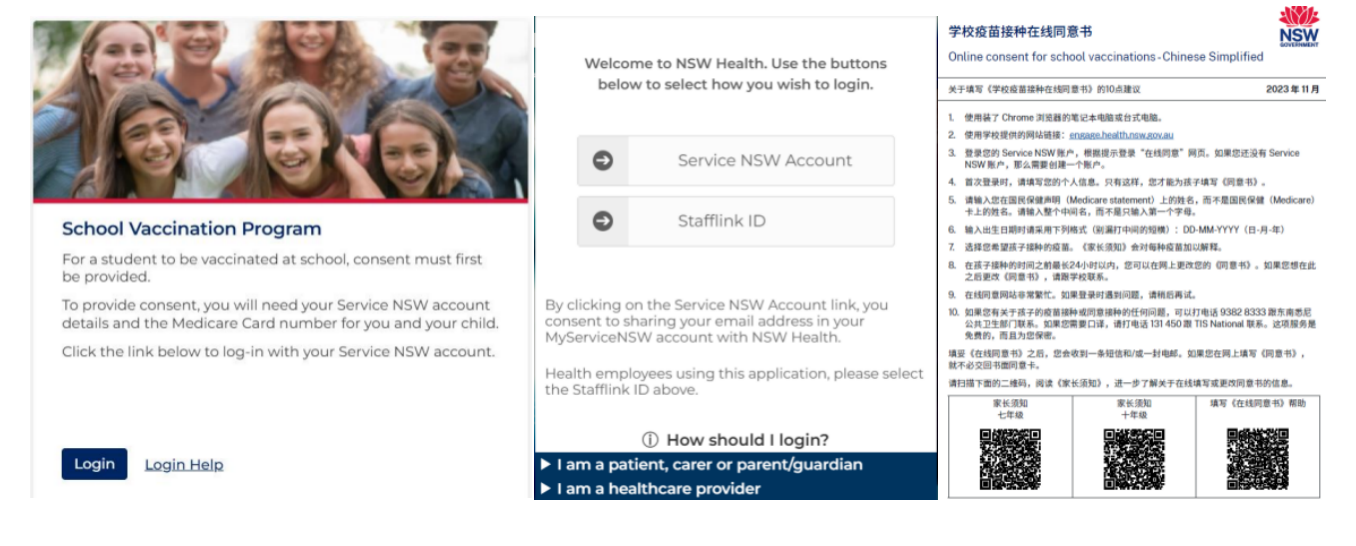
Parental informed consent is a prerequisite for program implementation and is designed to balance convenience and accessibility. Since 2023, NSW has introduced an online consent platform linked to the government service portal. Parents can log in using their Service NSW account, provide their child’s personal information and both their own and their child’s health insurance numbers, and complete the consent process online. The platform provides materials in multiple community languages, including Chinese-language resources for parents of Year 7 students, to accommodate culturally diverse populations. Paper-based consent forms are still available, with approximately 20% of families continuing to use this option. Each method has its advantages and limitations.
Paper forms may be lost during transmission between schools and families, while online consent facilitates data reporting but may be overlooked if parents miss email notifications. Nurses often contact parents by phone on vaccination days to ensure completion. A key advantage of the online system is that consent records are directly integrated into the system, allowing nurses to access real-time information on consent status, vaccine types approved, and student eligibility. Once vaccination is completed and recorded, the student’s status is updated accordingly, and the data are automatically synchronized with the national immunization register, forming a closed data loop from consent to vaccination.
In addition, catch-up vaccination is treated as a critical component of the program. During each school visit, students who missed previous doses but have parental consent are offered vaccination. Students who initiate vaccination in Year 7 can continue to receive catch-up doses in subsequent years, such as during Year 10 vaccination sessions or during visits for new cohorts of Year 7 students. Free catch-up vaccination is available until the student’s 20th birthday. For those who are unable to complete vaccination at school, parents may take their children to local clinics or pharmacies.
NSW Health has also developed resource packages, including parent information kits, template letters, and communication materials, to support adolescent health services in engaging with schools. Each vaccine is accompanied by a dedicated parent information package that includes frequently asked questions about the vaccine and disease, consent forms with vaccination records, privacy statements, and contact information for public health units. Prior to vaccination, students receive information cards outlining key points they should understand about the vaccination process. The official website also provides comprehensive information for parents and students under the adolescent vaccination program section.
A robust data feedback system supports continuous monitoring and evaluation. AIR constitutes a lifelong national database of immunization records. This system serves two main functions. First, it enables individuals and healthcare providers to access vaccination histories conveniently, supporting clinical decision-making. Second, it provides a basis for calculating population-level vaccination coverage. As Australia has universal health insurance coverage, the system uses the health insurance cards as the denominator, allowing accurate estimation of the target population size and comparison of vaccination coverage across age groups.
Outcomes, Lessons Learned, and Emerging Challenges
Monitoring data from 2011 to 2024 shows that vaccination coverage for school-based programs in NSW has remained stable at approximately 80%. Although the initial uptake of the meningococcal ACWY vaccine was slightly lower, it has now reached levels comparable to those of the HPV and dTpa vaccines. Following the inclusion of boys in the HPV vaccination program in 2013, coverage rates between males and females have been largely equivalent.
Under sustained high coverage, equity has been consistently maintained. Quantitative studies indicate that vaccination rates are not influenced by socioeconomic status, language background, or school type, including public, religious, and private institutions. This outcome reflects the combined effects of free vaccination policies, multilingual communication strategies, and standardized school-based delivery, ensuring equal access for students from diverse backgrounds.
Research has also identified multiple factors influencing vaccination uptake. At the school level, students in single-sex schools tend to have higher vaccination rates than those in coeducational settings, and student attendance plays a fundamental role. At the interpersonal level, trust between students and nurses, trust of teachers in nurses, and strong collaboration between schools and public health units are key drivers of high coverage. Qualitative studies of parents provide further insights into this trust mechanism, showing that parental acceptance of HPV vaccination is strongly influenced by its inclusion in the national immunization program rather than detailed knowledge about the vaccine itself.
Parents generally trust clinicians, researchers, and government authorities to ensure vaccine safety. Their preference for school-based vaccination is also driven by convenience, as it eliminates the need for appointments, avoids disruption to work, and provides peer support on vaccination days. However, awareness gaps remain, as parents tend to associate HPV vaccination primarily with cervical cancer prevention and have limited understanding of its benefits for males. All surveyed parents supported the inclusion of HPV vaccination education in schools, believing it would improve adolescent health literacy and support informed decision-making.
In recent years, particularly following the COVID-19 pandemic, the program has faced new challenges. Since 2020, vaccination coverage for all vaccines has shown a declining trend. In 2023, HPV vaccination coverage among 15-year-olds was 87.6% for girls and 84.3% for boys, decreasing further in 2024 to 85.1% and 81.0%, respectively, falling short of Australia’s target of 90%. Notably, these cohorts were in Year 7 during pandemic-related lockdowns, resulting in lower initial coverage compared to older cohorts, reflecting the lasting impact of the pandemic on routine immunization services.
In the post-pandemic context, increased vaccination anxiety among students, rising vaccine hesitancy, and misconceptions linking HPV vaccination to inappropriate sexual behavior, particularly in some religious school settings, have become key barriers. Experiences indicate that school-based vaccination programs commonly face operational challenges related to consent form return and catch-up vaccination, including incomplete or incorrect forms, signatures by non-guardians, expired consent forms, delays caused by seeking verbal consent on vaccination days, and limited resources for follow-up visits. Additional challenges include student refusal, weak linkage with community-based catch-up services, and incomplete vaccination records. These findings provide valuable references for further improving program implementation in NSW.
In conclusion, the successful implementation of school-based HPV vaccination in NSW demonstrates that a well-established school vaccination infrastructure, strong cross-sector collaboration, an experienced nursing workforce, and free and accessible vaccination services together form the foundation of high coverage. This system, which was built upon decades of sustained operation, has demonstrated resilience in the face of challenges such as the COVID-19 pandemic. Australia’s experience shows that introducing new vaccines through existing school health systems combined with continuous evidence-based optimization is an effective pathway to achieving high vaccination coverage among adolescents, offering important lessons for countries exploring school-based immunization models.
Content Editor: Tianyi Deng
Page Editor: Ruitong Li
References
[1]Ward KF, Menzies RI, Quinn HE, Campbell-Lloyd S. (2010) School-based vaccination in NSW. NSW Public Health Bulletin 21, 237–242. https://doi.org/10.1071/NB10046
[2]Vujovich-Dunn, C., Wand, H., Brotherton, J.M.L. et al. Measuring school level attributable risk to support school-based HPV vaccination programs. BMC Public Health 22, 822 (2022). https://doi.org/10.1186/s12889-022-13088-x
[3]Brotherton, J., Deeks, S., Campbell-Lloyd, S., et al. (2008). Interim estimates of human papillomavirus vaccination coverage in the school-based program in Australia. Communicable Diseases Intelligence Quarterly Report, 32(4), 457–461. https://search.informit.org/doi/10.3316/informit.504643428389985
[4]Complex intervention to promote human papillomavirus (HPV) vaccine uptake in school settings: A cluster-randomized trial https://doi.org/10.1016/j.ypmed.2023.107542
[5]School-based HPV vaccination positively impacts parents’ attitudes toward adolescent vaccination https://doi.org/10.1016/j.vaccine.2021.05.051
[6]Challenges, lessons learned and results following the implementation of a human papilloma virus school vaccination program in South Australia https://onlinelibrary.wiley.com/doi/abs/10.1111/j.1753-6405.2009.00409.x.
