
To strengthen local health policy and improve immunization programs across the country, Duke Kunshan University’s Innovation Lab for Vaccine Delivery Research (VaxLab) hosted a two-day training workshop in late January. Held from January 22 to 23, 2026, the “Training Workshop on Enhancing Research and Grant Application Capacity” aimed to equip local Centers for Disease Control and Prevention (CDCs) with the skills needed to drive evidence-based decision-making for China’s National Immunization Program.
A total of 16 participants, including immunization program managers and research staff from provincial and municipal CDCs and universities in Jiangsu, Shandong, Shaanxi, Chongqing, and other regions, gathered in Kunshan to engage in in-depth learning on policy research design and project proposal development.
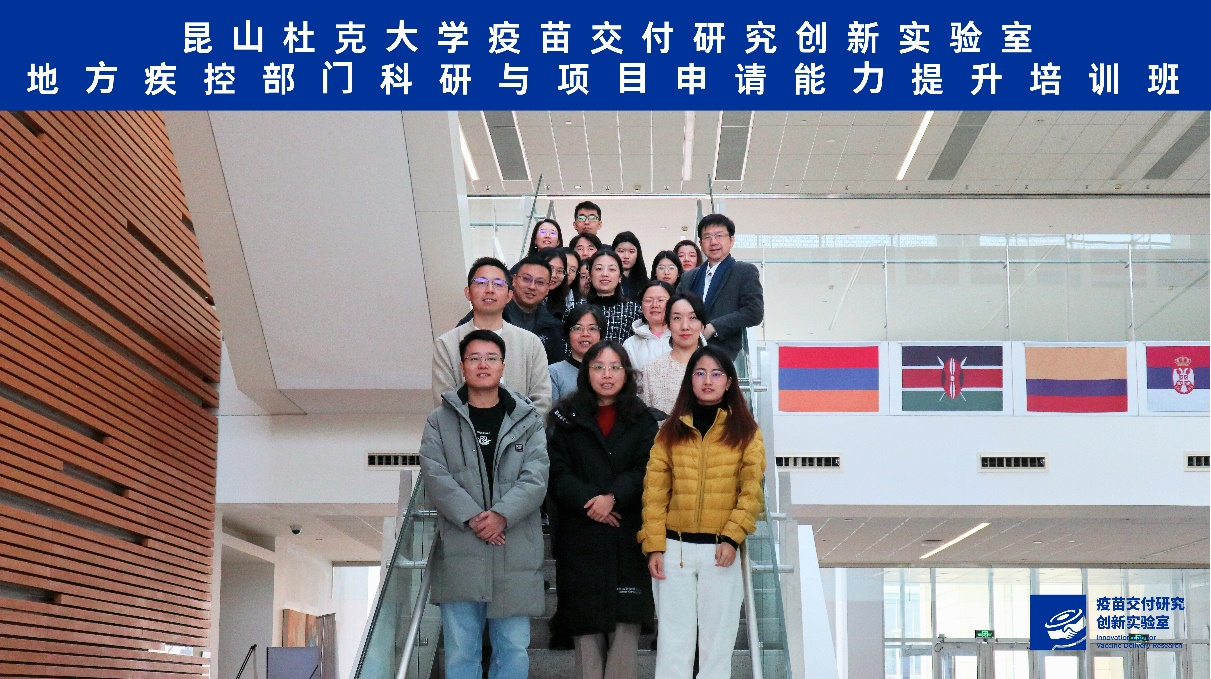
The training consisted of two main components: lectures and one-on-one guidance on research proposal development. The lecture sessions covered key topics, including the mid-term review of the Immunization Agenda 2030 (IA2030), policy analysis tools for introducing new vaccines into national immunization programs, and the design and methodology of implementation research in public health.
Professor Shenglan Tang, Co-Director of the Global Health Research Center at Duke Kunshan University and Director of the Innovation Lab for Vaccine Delivery Research, introduced the design and methodology of implementation research in public health. He highlighted the application of the RE-AIM framework across different contexts and shared insights on the logical structure and common pitfalls in developing high-quality research proposals, illustrated with practical case examples. The training also invited Dr. Shu Chen, Advisor at Duke University and Senior Global Health Research Fellow at the National Centre for Immunisation Research and Surveillance in Australia, to introduce the New Vaccine Introduction – Prioritization and Sequencing Tool (NVI-PST), providing participants with a policy analysis tool that bridges global perspectives and local practice.
A total of seven research teams participated in the one-on-one proposal mentoring sessions. Their research topics included vaccination coverage monitoring, studies on “zero supply” of non-NIP vaccines, and pathways for implementing HPV vaccination within the National Immunization Program. Professor Shenglan Tang, Dr. Shu Chen, Professor Mengcen Qian from Fudan University, Assistant Professor Xinyu Zhang from Duke Kunshan University, and Senior Researcher Lei Guo jointly provided facilitation and hands-on trainings to the CDC teams. Detailed discussions were held on key aspects of proposal development, including study design, sample selection, and budget planning. During the final session of the training, each research team delivered a 15-minute presentation of their proposed projects. Through on-site feedback and expert commentary, the teams refined their study designs further and improved the overall quality of their research proposals.
In the next phase of its work, the Innovation Lab for Vaccine Delivery Research will continue to prioritize capacity building and knowledge translation through expanded collaboration. Its task priority – encompassing training programs, research support, and co-development initiatives – is designed to strengthen local research capacity and policy influence. These efforts are central to advancing equitable access to immunization and bolstering the public health protections offered by vaccination.